
Best Erhu Masterpiece Ever – Moon Reflected on Second Spring
Best Erhu (Chinese Violin) Piece Ever – How?
“I should kneel down to listen to it!” — Ozawa Seiji, Japanese Conductor
One of the best known Chinese music inside and outside China
In 1985, an album of 11 Chinese music was introduced in USA, this one is the first.
When you talk about Chinese music, firstly you talk about Erhu (so called Chinese Violin); when you talk about Erhu, firstly you talk about this one – Moon reflected on Second Spring.
Blind Musician – Ahbing
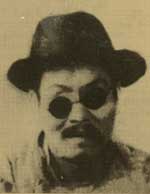
Blind Ah-Bing
Unlike its romantic name, this piece of music is full of heart-breaking sorrowness. The musician, Hua Yanjun (or Blind Ah-Bing), like all the other great artists along human history, had a very complicated life and suffered from WWII, poverty, disease and repression from corrupted authorities in the old China (before 1949). As an itinerant street performer, he was known to be able to play more than 600 Erhu and Pipa pieces, among which some were his compositions.
One of the only Six recorded out of 600+ pieces
When the New China established in 1949, academic visitors from Shanghai found him in order to preserve Chinese folk music, and successfully recorded 6 pieces performed by him. Although he happily agreed to record more later, he died a few month after the first record, taking along his talented music (only 6 out of 600+ were recorded.) It’s a great loss of Chinese music treasure. As one of the six, “Moon reflected on Second Spring” soon became popular in China, and was introduced internationally and gained popularity all over the world. People are touched by the sadness beauty of music, the legendary life of Ah-Bing, his spirit of integrity, honesty, and his talent.
An orchestra version by China Central National Orchestra (CCNO)
The 1950 original steel wire record performed by the original composer Blind Ah-bing.
Name of this music
When people finished recording this music, they asked Ah-Bing for a name. Ah-Bing said he did not have one. Then, people asked him where he used to play it, he said that sometimes at getto, sometimes by the Hui Spring (惠泉, crowned as “the second spring in the world” by Lu Yu – the Father of Tea). One proposed to name it “second spring”, another thought “second spring” was too simple to name a music. Since there is a famous scenic place in the West Lake of Hangzhou called “Three pools reflecting the moon”, similarly, people decided to name this music as “Moon Reflected on Second Spring”. And Ah-Bing liked this name.
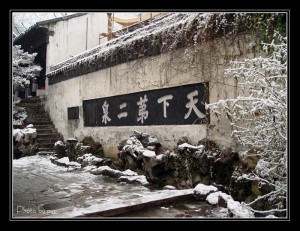
Second Spring in the World. Photo by [email protected]
English Translation of its Name
When it comes to English translation, some people who don’t know the background tend to translate as “Moon reflected on Double Springs”, which is definitely wrong. On the other hand, some people argue that “Second Spring” in English is too intriguing and it should use its original name and translated as “Hui Spring” – Moon Reflected on Hui Spring.
[References]
1. Ah-Bing wikipedia: http://en.wikipedia.org/wiki/Abing
[Chinese Keyword]
二胡 二泉映月

 (2 votes, average: 4.00 out of 5)
 Loading...
 Yi Liu


Beautiful music! Please don’t throw it away for “modern” music.
Ah Bing’s life story is very interesting. He was famous for comments on daily life and politics in his songs and performances during Japanese occupation. But he was only forbidden to perform in 1945, when the Japanese had left. This detail is only in the English Wikipedia entry, not in the Chinese one. On the other hand, the Chinese entry does mention that Ah Bing’s grave was desecrated in 1966, at the beginning of the Cultural Revolution. What happened to his remains seems to be unclear, maybe they were moved because of road construction in 1974. These later details are only in the Chinese entry. It’s probably best to hear the music without any pictures. Would you enjoy Bach or Mozart as a poignant background on gigantic feats of engineering? Railway workers deserve respect. On the other hand, modernization and development projects in Tibet, as well as in many other places in China, such as Kashgar, or Beijing’s Qianmen area, can result in severe and irreparable destruction of culture, nature and heritage. What would Ah Bing say?